 Subcut
Companies Sued by the FTC for Hard-to-Cancel Subscriptions
A live scoreboard of companies sued by the FTC for hard-to-cancel subscriptions: Amazon, Uber, LA Fitness, Chegg, Adobe, and what it means if you pay them.
You finally went to cancel a subscription, and the company turned a one-minute decision into a part-time job. A phone tree. A retention offer you did not ask for. A "cancel" link that loops you back to the start. It felt personal, and it felt deliberate, because it was.
Here is the direct answer. The Federal Trade Commission has sued or settled with a growing list of companies for making subscriptions hard to cancel: Amazon, Uber, LA Fitness, Chegg, Adobe, and Care.com are the recent headliners, with older cases against Grubhub, Epic Games, Vonage, and ABCmouse built on the same laws. Amazon paid the biggest penalty, $2.5 billion in September 2025 (FTC, September 2025).
This page is a scoreboard, not a news story. News articles freeze on the day they publish. We keep this one dated and re-verified, one card per company, each with the specific trick the FTC alleged, the visceral number, the penalty, and the part nobody else writes down: if you pay one of these companies, here is what you can actually do about it now.
First, the thing most articles get wrong
You may have read that the FTC's "click-to-cancel" rule is dead and concluded that companies are off the hook. Half right, wrong conclusion.
The 2024 Negative Option Rule (the "click-to-cancel" rule) was vacated by the Eighth Circuit on July 8, 2025, before it ever took effect, on a procedural ground: the FTC skipped a required preliminary regulatory analysis. That rule is gone.
But the lawsuits on this scoreboard were never built on that rule. They run on two older laws that the vacatur did not touch:
- The Restore Online Shoppers' Confidence Act (ROSCA). It requires clear disclosure of subscription terms, your express informed consent before you are charged, and a simple way to cancel.
- Section 5 of the FTC Act, which bans unfair and deceptive practices.
Chegg, LA Fitness, Uber, and Adobe were all charged or settled under those laws, several of them after the rule died. The FTC also reopened negative-option rulemaking with an advance notice in March 2026, so the topic is alive even though the rule is not. The short version: the click-to-cancel rule is gone, but the lawsuits using the older laws are not, and the cases below prove it.
The scoreboard
Biggest and newest first. Every penalty figure carries its date. For the two cases still in court, there is no penalty to report, only allegations, and we say so.
Amazon (Prime): $2.5 billion, September 2025
The penalty. $2.5 billion total: a $1 billion civil penalty (the FTC says the largest ever in an FTC rule-violation case) plus $1.5 billion set aside for consumer refunds. Amazon settled on September 25, 2025, three days into trial in the Western District of Washington (FTC, September 2025).
The dark pattern. The FTC alleged Amazon enrolled people in auto-renewing Prime without clear consent, hiding the opt-out in a confusing checkout, then funneled anyone trying to leave into a deliberately long exit.
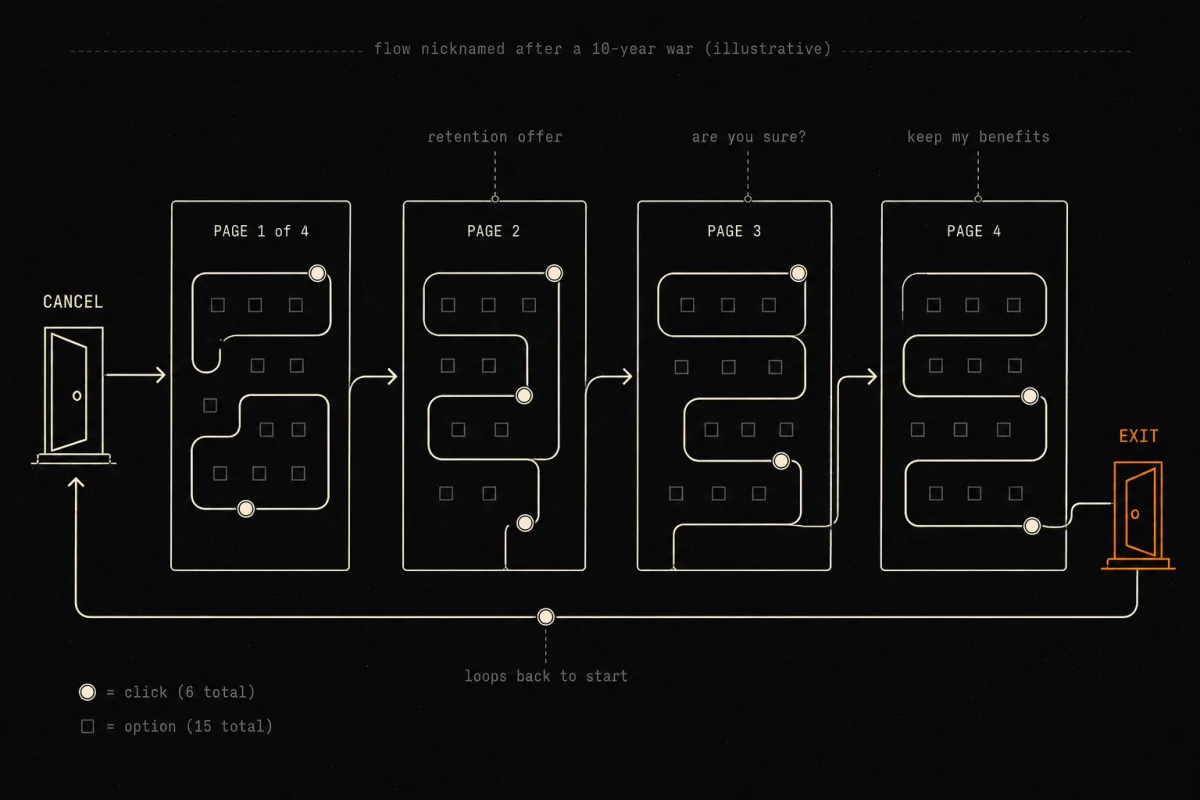
The detail you will not forget. Amazon internally named its cancellation flow "Iliad," after Homer's epic about the ten-year Trojan War, because it ran that long. The FTC described it as a four-page, six-click, fifteen-option gauntlet. Internal documents quoted by the FTC had employees calling subscription enrollment "a bit of a shady world" and describing the practice as "an unspoken cancer" (NPR, September 2025). Amazon named its cancel flow after a ten-year war. The name was the honest part. Roughly 35 million people were affected.
If you pay this company. The refund program is open. You may be eligible if you signed up for Prime between June 23, 2019 and June 23, 2025 through a challenged enrollment flow and used three or fewer Prime benefits in a year, or if you were enrolled by accident, or if you tried and failed to cancel online. Refunds run up to $51 per person. Some went out automatically in November and December 2025; claim notices started in January 2026; the claim deadline is July 27, 2026. Start at the FTC Amazon Refunds page. Neither Amazon nor the FTC will ever ask you to pay a fee to get your money, so anyone who does is a scammer. For the broader how-to, see our guide on getting a refund after an auto-renewal.
Uber (Uber One): case ongoing, no penalty yet
The status. No settlement. The FTC sued on April 21, 2025, and an amended complaint joined by 21 states and D.C. landed in December 2025. Litigation is ongoing as of June 2026, so there is no dollar figure, and we are not going to invent one (FTC, April 2025).
The alleged dark pattern. Charging people for Uber One without clear consent, overstating the savings, and making cancellation hard despite a "cancel anytime" promise.
The detail you will not forget. The FTC alleged that some users had to navigate as many as 23 screens and take as many as 32 actions to cancel. Within 48 hours of the billing date, the FTC says Uber removed the in-app cancel option entirely and forced people to contact customer service. The FTC also alleged Uber advertised "$25/month savings" without subtracting the cost of the Uber One subscription itself. 23 screens and 32 actions to cancel a food-delivery discount. Uber disputes the claims and says most cancellations take under 20 seconds in the app. Uber One had about 30 million members as of late 2024.
If you pay this company. The case is active, so there is no refund fund yet. But if you pay for Uber One and felt trapped in the cancel flow, your experience is exactly what the FTC is litigating. File a complaint at ReportFraud.ftc.gov so it lands in the database the FTC uses to build its case. If you want to understand the playbook behind the disappearing cancel button, we wrote about why companies make you call to cancel.
LA Fitness: case ongoing, no penalty yet
The status. Sued August 20, 2025. Still in litigation. The FTC alleges the conduct caused "hundreds of millions of dollars in unwanted recurring fees," which is an allegation of harm, not a penalty already imposed (FTC, August 2025).
The alleged dark pattern. Cancellation that was "exceedingly difficult." Memberships ran indefinitely unless cancelled, and cancelling meant going to the gym in person or mailing a notice.
The detail you will not forget. Consumers were told to send the cancellation form by certified or registered mail (a cost the customer had to eat), or hand-deliver it to a specific manager who was often not there. The FTC says tens of thousands of customers reported trouble cancelling. The defendants are Fitness International, LLC and Fitness & Sports Clubs, LLC, charged under Section 5 and ROSCA. Certified mail, to a named manager, who is conveniently out. That is the textbook illegal cancellation barrier.
If you pay this company. Active case, no fund yet. If you were charged after trying to cancel an LA Fitness or related membership, document the attempt (dates, receipts, the mail you sent) and file with the FTC. A "certified mail to a named manager" requirement is one of the clearest cancellation barriers ROSCA was written to stop.
Chegg: $7.5 million, September 2025
The penalty. $7.5 million, used to refund affected consumers (FTC, September 2025).
The dark pattern. An obstructive cancellation flow, continued billing after people asked to cancel, and a failure to honor attempts to stop the recurring charge.
Why this one matters most. Chegg is the post-vacatur proof point. It settled after the click-to-cancel rule was struck down, under ROSCA and the FTC Act. The order requires Chegg to provide a cancellation mechanism "at least as easy to use as the mechanism the consumer used to consent." Memorize that phrase. It is the standard you can hold up to any service: if signing up was one click and cancelling is a phone call, that mismatch is exactly what the FTC penalized.
If you pay this company. Refunds come from the $7.5 million fund. More usefully, the "at least as easy to cancel as to sign up" line is a sentence you can quote in your own complaint about any company, not just Chegg.
Adobe: $150 million in value, March 2026
The penalty. $75 million in cash plus $75 million in free services, $150 million in total value. Adobe settled in March 2026; the DOJ and FTC complaint was filed back in June 2024 (FTC consumer alert, May 2024).
The dark pattern. Hiding the early-termination fee on the "Annual, Paid Monthly" plan and making cancellation unfairly difficult.
The detail you will not forget. The Annual, Paid Monthly plan locked you into a year. Cancel after a two-week window and you triggered an early-termination fee of 50% of the remaining months. The FTC says Adobe buried that fee in small print or behind a hover-over icon. Coverage of the complaint quoted an Adobe executive likening the hidden termination fee to "heroin."
If you pay this company. The settlement requires Adobe to clearly disclose any early-termination fee before you enroll and to explain how it is calculated. If you got hit with a surprise 50% termination fee on an Annual, Paid Monthly plan, that is the exact conduct the FTC just made Adobe pay for, and it is worth asking for that money back. The annual-commitment trap goes well beyond Adobe, and the buried termination fee is how it bites.
Care.com: $8.5 million, refunds sent June 2025
The penalty. An $8.5 million settlement. The FTC sent more than $8.1 million to 194,207 consumers, with distribution announced in June 2025 (FTC, June 2025).
The dark pattern. Two-pronged. Deceptive earnings and job-availability claims to lure caregivers, plus a subscription trap on the family side: a cancellation process that, in the FTC's words, "didn't work," with some users billed after cancelling.
Why it is on the list. Tens of thousands of users complained the cancellation simply did not function. Care.com is the case that shows the FTC counts "cancellation that silently fails" as a ROSCA violation, not just cancellation that is hard to find. A cancel button that does nothing is still illegal.
If you pay this company. The refund distribution already ran (checks and PayPal to roughly 194,000 people), so this card is mostly here for the pattern it sets.
The crackdown did not start in 2025
If anyone tells you this is a recent fad the FTC will drop, point them at the older cases. All ran on ROSCA and Section 5, the same laws still in force today.
| Company | Year | Penalty | What it was about |
|---|---|---|---|
| Grubhub | December 2024 | $140 million (per coverage) | Deceptive practices including a hard cancellation process; order required cancellation as easy to find and use as signup |
| Epic Games (Fortnite) | 2022 | $245 million in refunds | Dark patterns and unwanted charges |
| Vonage | 2022 | $100 million in refunds | Junk fees and a hard-to-cancel process |
| ABCmouse (Age of Learning) | 2020 | $10 million | Auto-renewal and cancellation practices |
The point of this table is simple. The FTC was using these laws to claw back money from subscription traps years before the click-to-cancel rule existed, and it is still using them now that the rule is gone. The rule was never the only tool.
You are probably already paying a company on this list
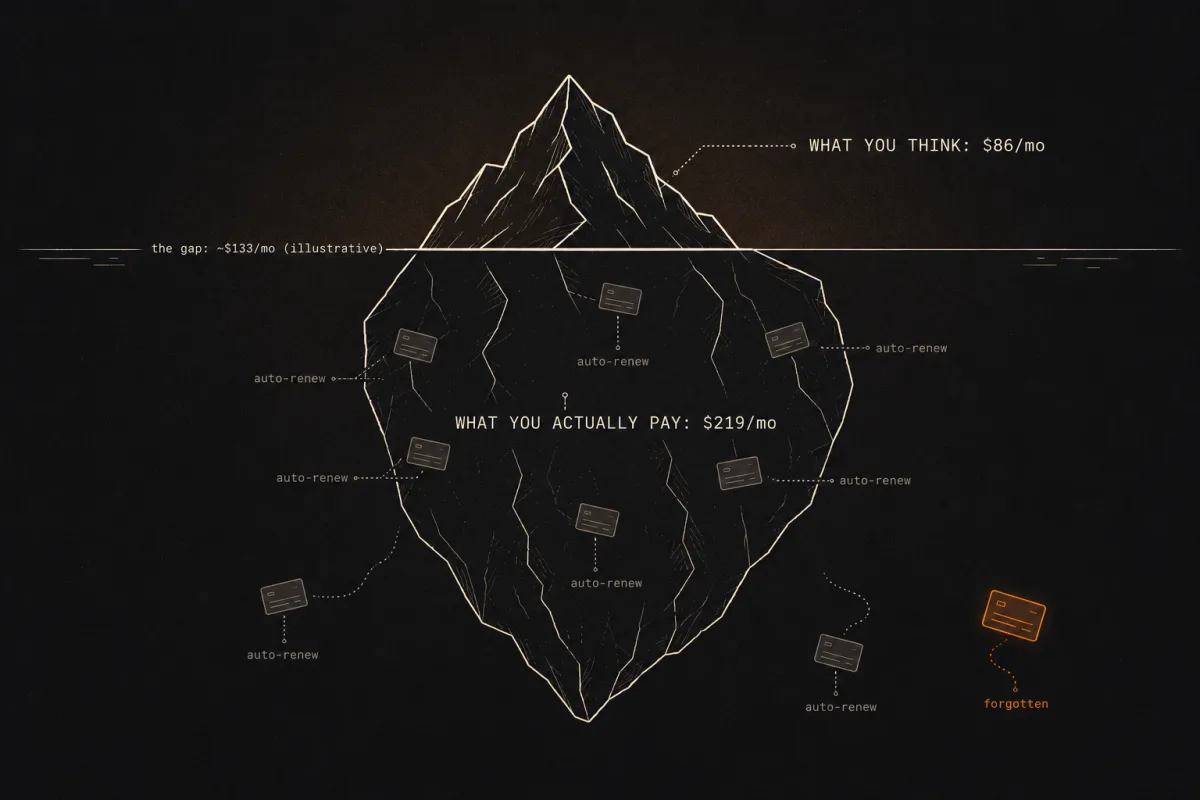
The crackdown stays abstract until it is your statement. Here is the uncomfortable bridge: most of us underestimate what we spend on subscriptions, and the companies above are some of the most common charges going.
C+R Research found that people estimated their monthly subscription spending at about $86 but actually spent around $219, a gap of roughly $133 a month, and that 42% of consumers had forgotten about a subscription they were still paying for (C+R Research, 2022). Forgetting is not a character flaw. It is the precise condition these cancellation flows are designed to exploit. The Iliad flow only works on people who are not watching.
This is where a free scan helps more than another article. The companies on this scoreboard are some of the most common recurring charges going, so it is worth checking whether any of them are sitting on your statement, and most people are surprised by at least one. If a charge on this list is a mystery to you, start with our guide to a recurring charge you don't recognize before you assume it is yours.
How to use the laws yourself
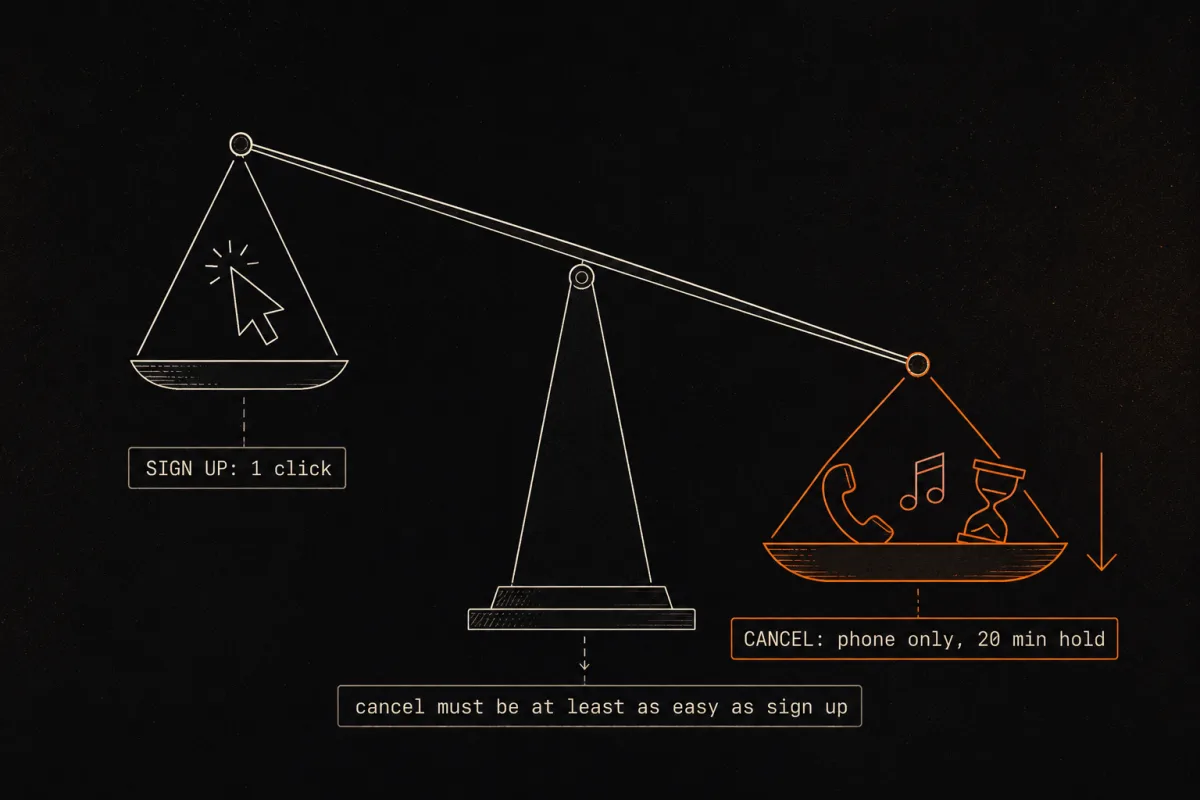
You do not need to wait for the FTC to sue. Three concrete moves:
- Quote the Chegg standard. Tell a company in writing that ROSCA requires a cancellation method "at least as easy to use as the mechanism the consumer used to consent," and that a one-click signup followed by a phone-only cancel does not meet it. You are no longer asking a favor. You are citing the rule the FTC just enforced.
- Report it. File at ReportFraud.ftc.gov. It feeds the Consumer Sentinel database the FTC uses to find patterns. The Uber and LA Fitness cases exist partly because tens of thousands of people did exactly this. You can report anonymously.
- Check your state law too. California, New York, Colorado, Connecticut, Vermont, and Illinois all have their own auto-renewal notice laws, and the Uber amended complaint added 21 states and D.C. as co-plaintiffs. State attorneys general are enforcing this alongside the FTC, which means more paths to a refund, not fewer.
Frequently asked questions
Which companies has the FTC sued for hard-to-cancel subscriptions? The recent list includes Amazon (Prime), Uber (Uber One), LA Fitness, Chegg, Adobe, and Care.com. Older cases under the same laws include Grubhub, Epic Games (Fortnite), Vonage, and ABCmouse. Amazon settled for $2.5 billion in September 2025. Uber and LA Fitness are still in active litigation.
Did the FTC's click-to-cancel rule actually take effect? No. The Eighth Circuit vacated it on July 8, 2025, before its compliance date, on a procedural defect: the FTC skipped a required preliminary regulatory analysis. But the older laws still apply, the Restore Online Shoppers' Confidence Act (ROSCA) and Section 5 of the FTC Act, and the FTC reopened negative-option rulemaking with an advance notice in March 2026.
Can I get a refund from the Amazon Prime FTC settlement? Possibly. Eligibility covers people who signed up for Prime between June 23, 2019 and June 23, 2025 through a challenged enrollment flow and barely used it, or who could not cancel. Refunds run up to $51 per person, the claim deadline is July 27, 2026, and some refunds went out automatically in late 2025. Neither Amazon nor the FTC will ever charge you a fee to claim.
Is my subscription company being investigated by the FTC? FTC investigations are usually nonpublic until a complaint or settlement is filed, so a company not appearing on the public list does not mean it is clean. It means there is no public action yet. Check the FTC's press releases and case search, and you can report the company yourself at ReportFraud.ftc.gov.
How do I report a subscription that is hard to cancel? File a complaint at ReportFraud.ftc.gov. It feeds the Consumer Sentinel database that the FTC uses to spot patterns and build cases. You can report anonymously, and your specific complaint can become part of the evidence in an action against the company.
What does ROSCA require subscription companies to do? ROSCA requires a company to clearly disclose the material terms before charging you, get your express informed consent, and give you a simple way to cancel. The Chegg settlement spelled out the cancellation standard as a method at least as easy to use as the one you used to sign up.
What is the biggest subscription cancellation fine ever? Amazon's $2.5 billion settlement in September 2025. The FTC said the $1 billion civil penalty portion of it was the largest ever in an FTC rule-violation case. The other $1.5 billion is set aside for consumer refunds.
See the charge before the FTC has to
This page is a record of companies that got caught. The better outcome is not waiting for a federal lawsuit to find out you have been paying for something you forgot about.
That is what Subcut does. It reads your bank statement, surfaces every recurring charge, and shows you the renewals coming up, so you can decide before the auto-renew, not after. One honest note, because we will not pretend otherwise: reading your statement sends the file to a remote service to parse it, so that part is not on-device. We would rather tell you that than dress it up. Subcut spots the charges and lays them out; the deciding and the cancelling are still yours to do.
So when a company on this list is quietly billing you every month, you find it on a calm Tuesday, not three days into someone's trial.
iOS - Free to use - No subscription required (ironic, we know)
Last updated: June 17, 2026. Next scheduled re-verification of every FTC link and figure: ongoing. Amazon claim deadline (July 27, 2026) is open as of this update.
Keep going
Sources
- FTC: Historic $2.5 billion settlement against Amazon (Sept 2025)
- FTC: Amazon Refunds page
- FTC: Action against Uber for deceptive billing and cancellation (Apr 2025)
- FTC: Sues LA Fitness over hard-to-cancel gym memberships (Aug 2025)
- FTC: Chegg to pay $7.5 million over unlawful cancellation practices (Sept 2025)
- FTC consumer alert: Adobe used a hidden fee to trap people (May 2024)
- FTC: Sends more than $8.1 million to consumers harmed by Care.com (June 2025)
- ReportFraud.ftc.gov: file a complaint
- NPR: The dark patterns at the center of the FTC's Amazon case (Sept 2025)
- C+R Research: subscription spending survey (the $133/month gap)