 Subcut
Why Companies Make You Call to Cancel (and How to Win)
Why companies make you call to cancel: friction is the retention plan. The script, the certified-mail fallback, and your right to cancel online.
You signed up in about thirty seconds, from your couch, with your thumb. Now you want out, and suddenly the only door is a phone number that is open weekday afternoons, has a wait time that outlasts your lunch break, and ends in a person whose job is to talk you out of it. You have probably thought about just letting the charge ride for another month so you do not have to deal with it. That feeling is the entire point.
Here is the direct answer. Companies make you call to cancel because friction is the retention strategy. The hold time, the limited hours, and the trained rep are not bugs in the system, they are the system. Each one is a chance to make leaving annoying enough that you give up, and a measured fraction of people do. To win, you have three levers: a broken-record cancellation script, a written cancellation by certified mail when the phone line is a dead end, and your state's right to cancel online if you signed up online. The federal Click-to-Cancel rule that everyone keeps citing was struck down in July 2025, so the protections that actually bite today are state law and a federal statute called ROSCA.
This is not your imagination, and it is not a customer-service hiccup. It is a documented pattern, and below is how the machine works, then how to beat it.
The call is the product, not a courtesy
Start with the motive, because once you see it you cannot unsee it. A subscription business knows that a slice of customers, when leaving gets tedious, will simply not finish. So the friction has a job: convert "I want to cancel" into "I will deal with it later," which often means never. The phone wall is the highest-friction version of the cancel flow, and that is exactly why it survives.
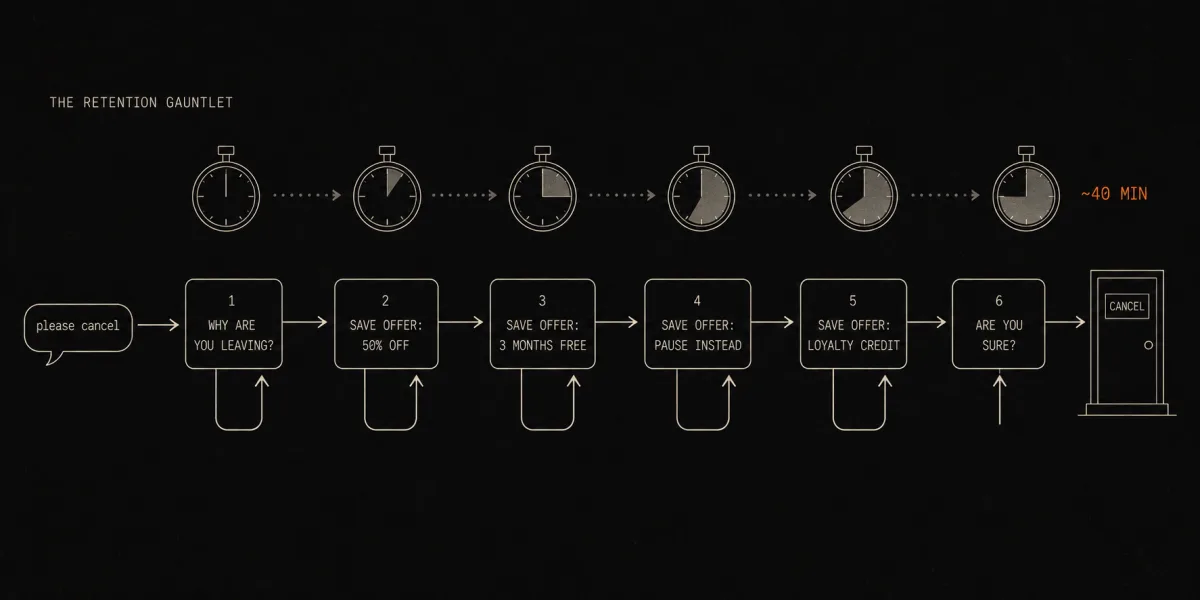
You do not have to take that on faith, because a regulator put the mechanism on the record. In November 2024, the New York Attorney General's office announced that SiriusXM violated the law with a deliberately difficult cancellation process. The findings read like a training manual for delay. The company trained agents to conduct a "six-part conversation" that included a series of questions and as many as five retention offers, all to slow the cancellation down. Agents were trained, in the AG's words, "not to take 'no' for an answer" and to "keep bombarding customers with questions or offers until they either relent or become frustrated."
The documented cases are the part that gives it away. The same press release describes one chat that ran 40 minutes despite repeated cancellation requests, and a separate call, lasting nearly 40 minutes, that involved a 92-year-old customer. When a company designs a script that turns "please cancel" into a six-part interrogation, the hold time is not a side effect. It is the design. As Attorney General Letitia James put it, "No one should have to endure a lengthy and frustrating process to cancel a subscription, and any company that forces customers to jump through unnecessary hoops to end their subscriptions is breaking the law."
There is one more reason the phone wall is uglier than it looks. It locks out people who cannot easily use a phone. As Modern Retail reported, citing the marketing firm Nineteen Insights, more than 68 million Americans with disabilities control roughly $490 billion in disposable income, and a phone-only cancellation effectively excludes Deaf and hard-of-hearing customers from a basic ability to stop paying. A cancel flow you cannot complete is not a cancel flow. When an entire industry independently lands on "make them call and put a trained closer on the line," that is not a coincidence. That is a playbook.
What you are actually fighting for
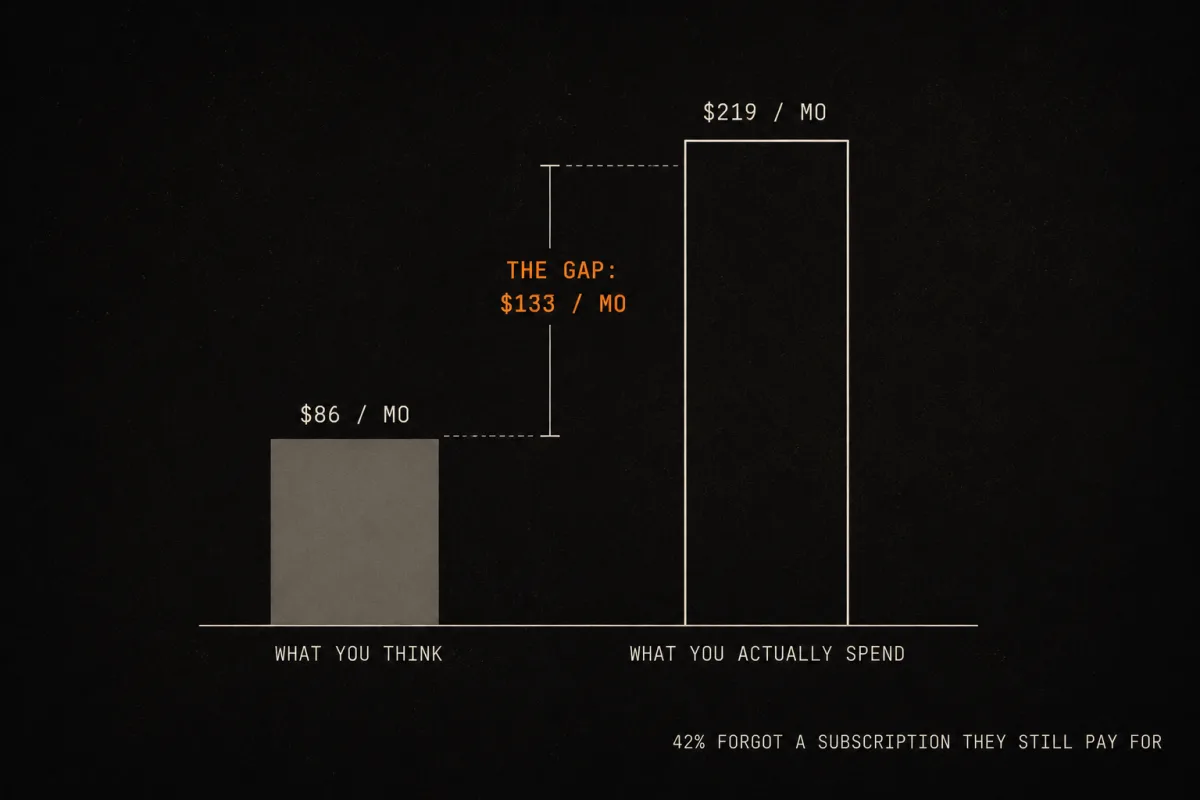
It is worth naming the stakes, because the reason this matters is money you forgot you were spending. C+R Research found in 2022 that the average American spent about $219 a month on subscriptions while estimating only $86, a gap of roughly $133 every month. The same survey found that 42% of people had forgotten about a subscription they were still paying for. The phone wall thrives in that gap. The harder a thing is to cancel, the more likely it slips back into the pile of charges you no longer notice.
So the goal is not just to win one call. It is to stop paying for the things you already decided to leave, and to make the decision before the renewal date instead of in the cancel flow, where the deck is stacked.
Lever 1: the broken-record script that gets past the rep
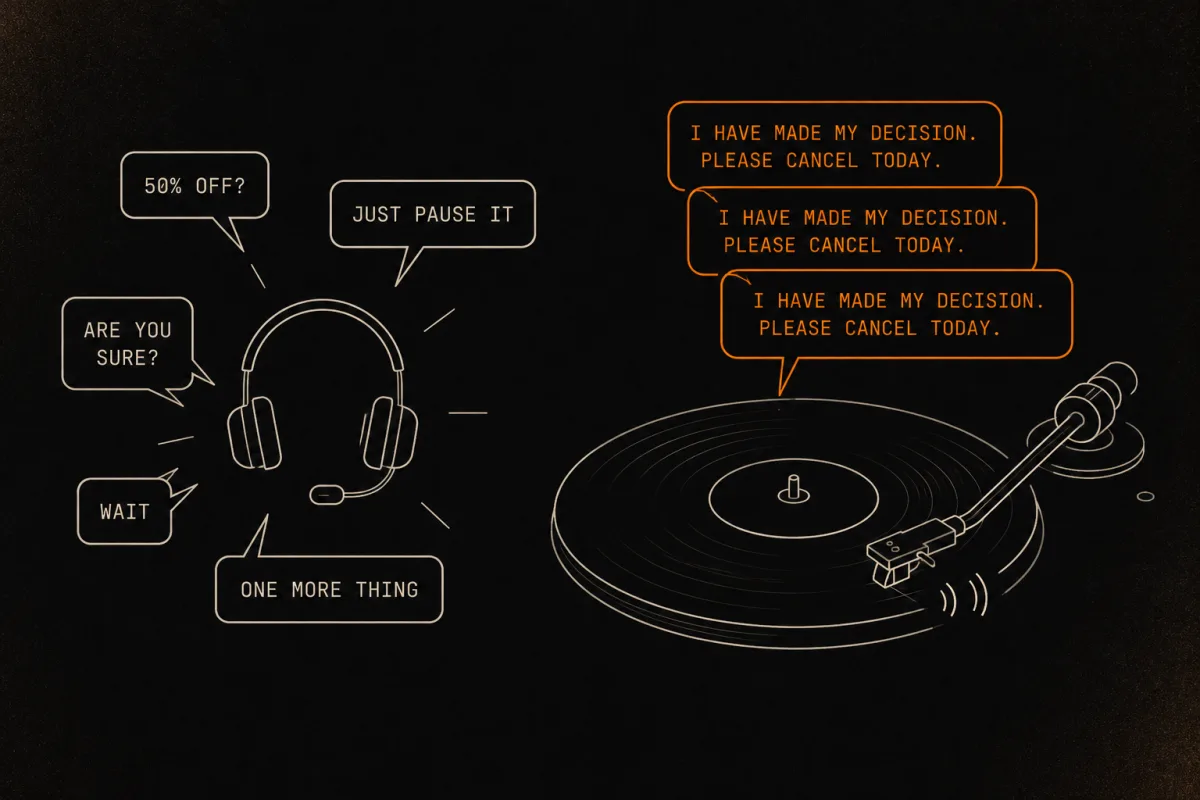
The retention call is predictable, which is good news, because predictable things can be beaten with a plan. The rep will ask why you are leaving, then offer a discount, then ask again. Your only job is to be boring and immovable.
Open with a reason that pre-empts the survey. Try: "Hi, I'd like to cancel my subscription. The price has become too high for me." Leading with a clean reason skips a few rounds of the script.
When the offer comes, decline once and then repeat one sentence. Something like: "I appreciate the offer, but I've made my decision. Please cancel the subscription effective today and email me written confirmation." Then say it again. And again, the same way, if you have to. Reps are trained to win arguments, not to win silence, so do not argue the merits of the discount. You are not negotiating. You are repeating.
Before you hang up, get two things in writing or out loud: a cancellation or confirmation number, and the name of the person you spoke with. If they later claim there is no record, you have one.
One honest aside, because it is genuinely useful: if you actually want to keep the service for less, the first offer is rarely the best one, and offers tend to escalate right after a price increase or just before renewal. Asking "is there anything better you can do" can work. But that is a different goal. If you came here to leave, the broken record is the move, and haggling just hands the rep more time on the clock.
Lever 2: cancel in writing by certified mail
When the phone line is a genuine dead end (perpetual hold, "our system is down," hours that never line up with your life), stop calling and start a paper trail. Put the cancellation in writing and send it by certified mail, return receipt requested. That gives you two things a phone call never will: proof of exactly what you sent, and proof that they received it.
Keep the letter short and include:
- Your account number and the email or phone on the account
- The date you are cancelling, stated plainly
- An explicit line that you revoke authorization for any further charges
- A request for written confirmation of the cancellation
This matters beyond the cancellation itself. The return receipt is the evidence you attach if they keep charging you anyway, which is where the next lever comes in.
Lever 3: dispute the charge with your bank (last resort, with timing)
If you cancelled and they charge you again, that later charge is the kind of thing your card issuer exists to handle. You can dispute it by contacting your bank, and the FTC advises following up any phone or online dispute with a written letter to the billing-error address. Chase's guide to disputing a credit card charge walks through the steps your issuer will expect.
Timing is the part people get wrong, so be precise:
| Step | The window that matters |
|---|---|
| File the dispute | Within 60 days of the statement that first shows the charge |
| Issuer acknowledges | Generally must acknowledge in writing within 30 days |
| Resolution | Usually within two billing cycles, up to 90 days |
One caveat in the spirit of being straight with you: a chargeback is the remedy for charges that hit after you cancelled, not a shortcut to make a subscription free. It is the receipt you keep when a company ignores you, not the first thing you reach for. If you got auto-renewed and want that specific charge back, the cleaner path is usually asking the merchant first, which we cover in how to get a refund after being auto-renewed.
Lever 4: the one that may make the wall illegal where you live
Here is the part most consumer pages get wrong, so read it slowly. There is a lot of writing online that tells you "Click-to-Cancel" is now the law and you can cancel anything online. That is not true. The FTC finalized a Click-to-Cancel rule in October 2024, but the Eighth Circuit Court of Appeals struck it down in its entirety on July 8, 2025, on procedural grounds, before it ever took effect. The FTC restarted the process with an advance notice of proposed rulemaking submitted on January 30, 2026, and is taking public comments due April 13, 2026, but that is a proposal, not a law. So do not anchor anything to that rule.
What actually protects you today is two things:
State automatic-renewal laws. Roughly 30 states have them, and some are stricter than the vacated federal rule. The pattern that helps you most is same-medium cancellation: if you signed up online, the business must let you cancel online without obstructing steps. California, Colorado, New York, Delaware, and Illinois have versions of this on the books, and the list is growing. In California specifically, a 2025 amendment requires businesses to let consumers "terminate the service exclusively online, at will, and without engaging any further steps that obstruct or delay" cancellation, and a "click to cancel" button must appear right next to any save offer, per the California Attorney General's consumer alert. If you live in one of these states and signed up online, the phone-only wall may itself be unlawful.
ROSCA, the federal Restore Online Shoppers' Confidence Act. This is the live federal law that the SiriusXM ruling rested on, and the FTC has confirmed it keeps that authority even with the Click-to-Cancel rule gone. Enforcement has not slowed down: as Gibson Dunn notes, the FTC sued Uber in 2025 over its subscription cancellation practices and is pursuing negative-option cases under ROSCA and Section 5 of the FTC Act. The SiriusXM order even required the company to drop the requirement that customers speak or chat with a live agent to cancel in New York. The phone-only wall is on thin legal ice, and you can say so on the call.
If you hit a wall and you live in one of those states, you have a real card to play: tell the company you signed up online and your state requires online cancellation, and that you will report a phone-only requirement to your state attorney general and to the FTC at ReportFraud.ftc.gov. You will sometimes find the online cancel button appears faster than the rep claimed. For the broader picture of who is being held to account and how the law is moving, our FTC subscription crackdown scoreboard tracks the cases and the timeline.
The fastest win is never needing the call
Every lever above is damage control after the trap is set. The cleaner move is to decide before the renewal date, when the company has no rep on the line and nothing to bargain with, instead of fighting through the cancel flow at the worst possible moment.
That means knowing what renews and when. The hard part is that most people genuinely do not, which is the whole reason the $133-a-month gap exists. The same retention playbook running on SiriusXM is running quietly on the other apps on your statement, and the ones you forgot about are the ones that win.
This is the part where we mention that this is literally what we built Subcut for. Subcut flags a renewal before it hits, so you can cancel ahead of the billing date rather than from inside a retention queue. It surfaces the recurring charges you stopped noticing, including the phone-only ones that are hardest to leave. To find what is hiding on your card in the first place, here is how to find your subscriptions from a bank statement.
iOS · Free to use · No subscription required (ironic, we know).
Frequently asked questions
Why do companies make you call to cancel instead of letting you do it online? Because friction is the retention plan. Long hold times, weekday-only hours, and a rep trained to keep you are not accidents, they are the product. New York's investigation into SiriusXM found the company trained agents to run a six-part conversation with as many as five retention offers and not to take no for an answer. Making you call buys them one more chance to talk you out of leaving.
Is it legal for a company to make you call to cancel? It depends on your state and how you signed up. If you enrolled online in California, Colorado, New York, Delaware, or Illinois, the phone-only wall is likely unlawful, because those states require businesses to let you cancel the same way you joined. The federal Click-to-Cancel rule was struck down in July 2025, so it is state automatic-renewal laws and the federal ROSCA, not that dead rule, that protect you today.
How do I cancel a subscription when they only let me call? Use a broken-record script: state that you want to cancel, give a reason like the price, decline every save offer with the same sentence, and get a confirmation number and the rep's name before you hang up. If the phone line is a dead end, send a cancellation letter by certified mail with return receipt. If they keep charging after you cancelled, dispute the charge with your bank.
How do I get past the retention rep and the here-is-50-percent-off offer? Decline once, then repeat the same sentence: I appreciate the offer, but I have made my decision, please cancel effective today and email me written confirmation. Reps are trained to win arguments, so do not argue the merits. Repeat, do not negotiate, and write down the cancellation number and the rep's name.
Can I cancel a subscription in writing instead of calling? Often yes, and it builds a paper trail. Send a cancellation letter by certified mail, return receipt requested, so you have proof of what you sent and proof they received it. Include your account number, the cancellation date, an explicit statement that you revoke authorization for further charges, and a request for written confirmation.
What states require companies to let you cancel online if you signed up online? California, Colorado, New York, Delaware, and Illinois are among the clearest, and roughly 30 states have automatic-renewal laws, some stricter than the vacated federal rule. The common thread in the strongest ones is same-medium cancellation: if you signed up online, the business has to let you cancel online without obstructing steps.
What happened to the FTC Click-to-Cancel rule? The FTC finalized it in October 2024, but the Eighth Circuit struck it down on July 8, 2025, before it ever took effect, on procedural grounds. The FTC restarted the process with an advance notice of proposed rulemaking submitted on January 30, 2026, with public comments due April 13, 2026. It is not currently law, so do not rely on it.
Researched and written by the Subcut team. Last verified: 2026-06-17.
Spot something off, like a state law that changed or a cancel line that finally went online? Tell us at hello@getsubcut.app and we will re-verify.
Keep going
Sources
- New York Attorney General: James stops SiriusXM from trapping customers in unwanted subscriptions
- Modern Retail: why call-to-cancel policies are an accessibility nightmare
- California Attorney General consumer alert on the Automatic Renewal Law
- Sidley Austin: US FTC Click-to-Cancel Rule struck down (July 2025)
- Gibson Dunn: FTC restarts negative-option rulemaking; ROSCA enforcement continues
- Chase: how to dispute a credit card charge
- C+R Research 2022 subscription survey, via CNBC