 Subcut
How Much Am I Spending on AI Subscriptions?
How much am I spending on AI subscriptions? The average AI subscriber pays about $66/month across 4 tools. Here's how to audit your stack and cut the overlap.
You signed up for one AI tool. Then a second one looked better at something, so you kept both "just to compare." Then a coworker swore by a third. None of them felt expensive, because each one was just $20 and they renew on different days. Now you genuinely cannot say what you pay per month, which is why you searched this.
Here is the direct answer. Among people who pay for AI at all, the average is about $66 a month across roughly four tools, per a 2025 Bango survey of US AI subscribers. Most individual tools cost $20 a month, per PNC Bank data reported by CBS News in 2026. So your real number is probably higher than the $20 you remember, and the only way to know it is to add up the charges instead of trusting your memory. The rest of this page is how to do that, and how to decide what to cut.
We will skip the part every other page does (a giant price grid that assumes you already want to buy) and go straight to the thing nobody covers: how to figure out what you pay in total, which tools genuinely don't overlap, and the honest verdict that most people need one general AI assistant, maybe two specialist tools, and almost never three of the same thing.
First, count your real total (it's bigger than you think)
People are not good at this, and it's not a character flaw. C+R Research found in 2022 that consumers underestimate their monthly subscription spend by $133: they guessed $86 and were actually paying $219, as CNBC's write-up of the C+R survey lays out. The same study found 42% of people had forgotten a subscription they were still paying for. AI tools are built to land in exactly that blind spot: $20 at a time, auto-renewing, on staggered dates.
The 2025 Bango survey makes the AI-specific version concrete. Among AI subscribers, 24% spend over $100 a month on AI tools, and 21% say AI is now their single most expensive subscription category. This is no longer a rounding error in your budget. For a lot of people it is the budget's biggest line, hiding in $20 pieces.
So the first move is not to compare features. It is to read your bank or card statement for the last three to six months and write down every AI charge you find. Six months matters because annual AI plans only renew once a year, and those are the ones you forget. If you want help pulling them out of a statement without handing over a bank password, we wrote a full method here: find subscriptions from a bank statement with no bank login. Once you have the list, this page does the rest.
One warning while you read: AI tools rarely show up on your statement as their own name. A charge can read "OPENAI," "ANTHROPIC," or appear as an "apple.com/bill" line if you subscribed inside an iOS app. If a charge looks unfamiliar, that's usually the descriptor, not a fraud. Here is why a subscription shows a different name on your statement so you can match each line to a tool.
The 2026 prices, so the math is real

Here are the current entry prices, verified June 2026. Cross-check the vendor pages before you act on the high tiers, because AI pricing moves fast (more on that below).
| Tool | Entry tier | Monthly | Annual | High tiers |
|---|---|---|---|---|
| ChatGPT (OpenAI) | Plus | $20 | Plus is monthly-only | Pro 5x $100, Pro 20x $200 |
| Claude (Anthropic) | Pro | $20 ($17/mo billed annually) | $204/yr | Max 5x $100, Max 20x $200 |
| Perplexity | Pro | $20 ($16.67/mo billed annually) | $200/yr | Max $200 |
| Google Gemini | AI Pro | $19.99 | $199.99/yr | AI Ultra 5x $99.99, Ultra 20x $200 |
Sources: official ChatGPT pricing, official Claude pricing, Perplexity pricing breakdown (FelloAI, 2026), and Google's own I/O 2026 AI subscriptions post.
The cleanest anchor for "how much am I spending on AI subscriptions" is the most-searched trio: ChatGPT Plus plus Claude Pro plus Perplexity Pro, three tools at $20 each. That is $60 a month, or $720 a year, for a stack that, as we are about to show, mostly does one job three times.
Want this done with your actual numbers instead of these example ones? Our subscription cost calculator turns the charges you found on your statement into a real monthly and annual total, so you stop guessing.
The overlap map (this is the part nobody else gives you)
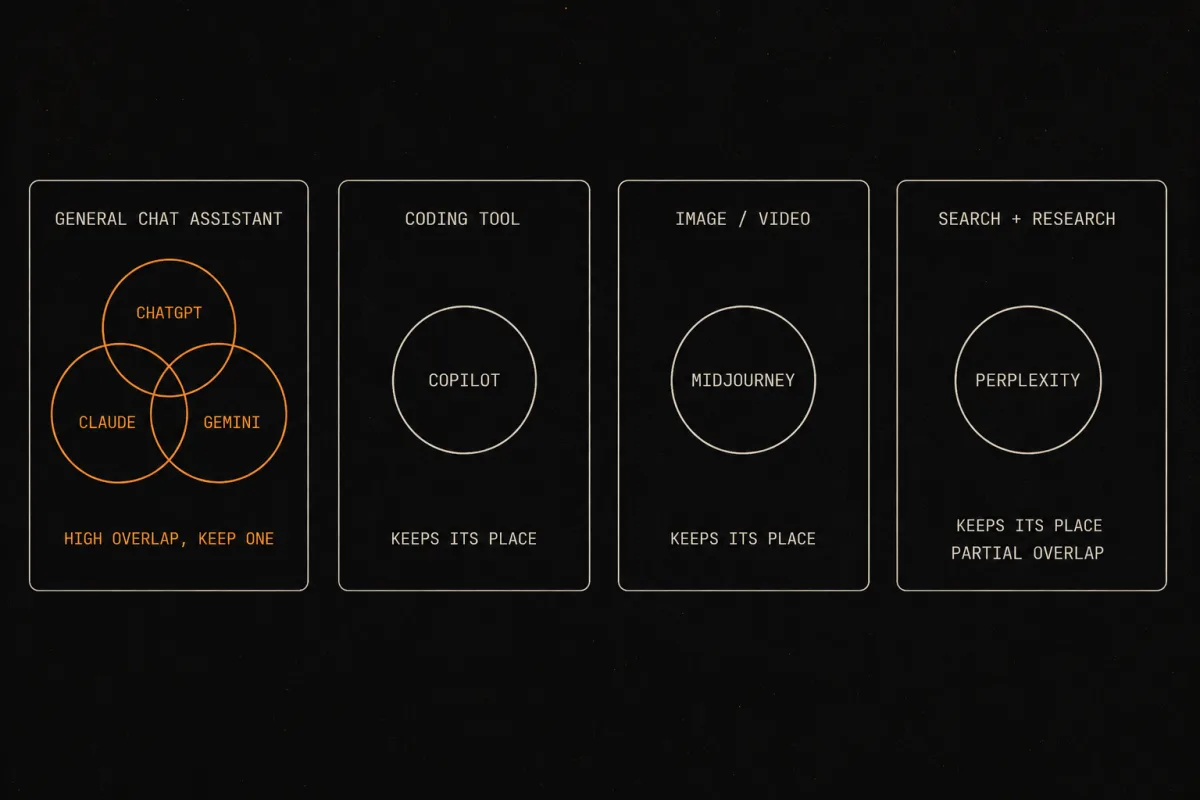
The whole trick to auditing an AI stack is one rule: AI tools fall into functional categories. Tools in different categories rarely overlap. Tools in the same category almost entirely do.
| Category | What it's for | Examples | Overlap verdict |
|---|---|---|---|
| General chat assistant | Drafting, brainstorming, Q&A, summarizing, reasoning | ChatGPT Plus, Claude Pro, Gemini AI Pro | High overlap. Two is mostly redundant. Three is hard to justify. |
| Coding tool | In-editor completion, agentic coding | GitHub Copilot, Cursor, Claude Code | Low overlap with chat. One is defensible. |
| Image or video | Generating images or video | Midjourney, Runway, DALL-E inside ChatGPT | Low overlap with chat or coding. One is defensible. |
| Search and research | Sourced, real-time web answers with citations | Perplexity Pro | Partial overlap. ChatGPT and Gemini now cite web sources too. |
So the defensible stack, in one line: one general chat assistant plus one coding tool plus one image tool is three non-overlapping subscriptions, and that's fine. Three general chat assistants (ChatGPT and Claude and Gemini) is two redundant subscriptions wearing a trench coat. For everyday use they draft, brainstorm, summarize, and answer the same questions. You will have a favorite. Keep that one.
The honest nuance: the assistants do have different strengths. Claude is widely rated stronger on long documents and natural writing, ChatGPT on breadth and tool integrations, Perplexity on cited real-time research. That is a reason to choose which one you keep, not a reason to keep all of them. Plenty of people have canceled Perplexity and folded that use into ChatGPT or Claude at the same $20, as the Perplexity vs Claude comparison on G2 lays out.
The two traps that hide your total
Trap one: the trial that became a habit
AI tools push free trials and free tiers hard, then convert quietly. This is the blind spot they aim at: C+R Research found in 2022 that 74% of consumers say it's easy to forget about their recurring monthly charges. The AI-specific version is sneakier still. You add a second or third assistant "to test it," never cancel the first, and now you pay for two or three tools doing the same job. The trial isn't the problem. The un-cancelled trial is. The fix is a reminder on the renewal date, not willpower.
Trap two: staggered renewals (the real reason you can't name your total)
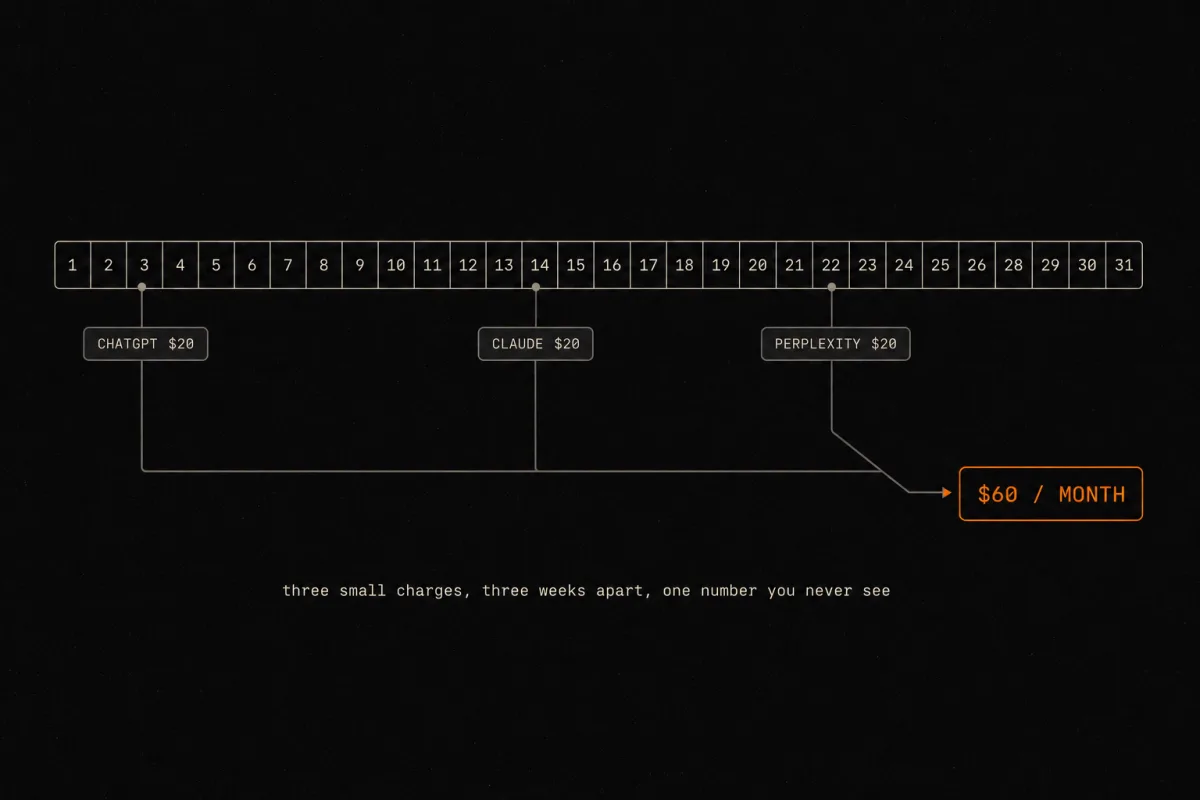
This is the big one. Say ChatGPT bills on the 3rd, Claude on the 14th, and Perplexity on the 22nd. That $60-a-month stack never appears as $60 anywhere. It appears as three separate "just $20" charges, three weeks apart, each small enough to ignore. The total is real, but you are never shown it in one place.
This is exactly why the perception gap exists. When 54% of AI subscribers say AI pricing is confusing or too complicated (Bango, 2025) and 72% of people put their subscriptions on autopay (C+R Research, 2022), staggered $20 charges are designed to sit just below the threshold where you'd notice the sum. The numbers don't even hold still: in early 2026 alone, OpenAI added a $100 ChatGPT Pro tier in April, and Google cut Gemini's top "Ultra" plan from $249.99 to $99.99 at its May I/O event, per Engadget's report on the Google AI Ultra price change. If even the list prices won't sit still, your memory of "what I pay for AI" was never going to be accurate.
The fix is simple and unglamorous: see every recurring AI charge in one list, on the dates it actually hits. That is what reading your statement does, because the charges that quietly auto-renewed are the ones you never logged in to notice.
The cut order
Once you have your real list, work it in this order. It goes biggest-win-first.
- List every AI charge from your statement, not your memory. You will probably find one you forgot. (See the 42% who do, per C+R Research, 2022.)
- Cut the second and third general chat assistant. If you pay for ChatGPT and Claude and Gemini, keep the one whose answers you actually prefer and drop the rest. This is the single biggest redundancy and the easiest cut.
- Drop any $100 or $200 tier you're on by default. The $100 step is the "5x" tier (ChatGPT Pro 5x, Claude Max 5x, Gemini Ultra 5x). The $200 step is the "20x" tier (ChatGPT Pro 20x, Claude Max 20x, Perplexity Max, Gemini Ultra 20x). Both are power-user money. If you can't name the specific limit you keep hitting on the $20 plan, go back to $20. The $100 middle tier is the easiest one to drift into and the least often necessary.
- Re-examine Perplexity. If your chat assistant now does sourced web search well enough for you, Perplexity may be redundant. Keep it only if the cited-research format is genuinely how you work.
- Keep the true specialists. One coding tool, one image tool. These don't overlap with chat and usually earn their place if you actually use them.
- Put the renewal dates somewhere you'll see them so a paused-then-forgotten tool doesn't quietly resume next month.
The plain verdict: most people need one general chat assistant and maybe one or two specialist tools. Almost nobody auditing their spending actually needs three general chat assistants or a $200 tier they can't justify. With the average AI subscriber holding roughly four tools, per the 2025 Bango survey, the gap between what people hold and what they need is the whole story.
If a charge turned out to be a renewal you never meant to keep, you may be able to get the money back. Here is how to get a refund after a subscription auto-renewed.
How to actually cancel the ones you don't use
Cancel through whatever you subscribed on, because the billing channel decides where the off switch lives.
- Subscribed on the web? Cancel on the vendor's own site, in account or billing settings. ChatGPT, Claude, Perplexity, and Gemini all have clean, self-serve cancel flows. There's no retention maze to fight here.
- Subscribed inside the iOS app? That charge is billed by Apple, not the AI company, so it shows as "apple.com/bill" and you cancel it in your iPhone's Settings, under your Apple Account, then Subscriptions. Canceling inside the app itself won't work, because the AI vendor doesn't control that billing.
That billing split is the one genuinely confusing part, and it's why a charge you can't place is usually an Apple-billed AI app, not fraud. The good news for this topic: the hard part of AI subscriptions is noticing the charge, not stopping it. The vendors here don't run the call-to-cancel playbook. The cost creeps in through overlap and staggering, not hostile cancel screens.
See the whole AI bill before it hits
You read this because three small charges added up to a number you couldn't name. That's the design working as intended, and it's running on every other subscription you have, not just the AI ones.
Subcut reads the recurring charges off your statement and shows your AI renewals on the dates they'll actually hit, so the $60-a-month stack finally appears as one number instead of three you-forgot-about ones. One honest note, because we won't pretend otherwise: importing a statement sends the file to Subcut's AI service (Gemini and Claude) to read it. There's no bank login and no standing connection to your account, but the file is processed by a remote service, not on your phone. After that, the list, the totals, and the renewal alerts are yours to act on.
iOS - Free to use - No subscription required (ironic, we know).
FAQ
How much do most people spend on AI subscriptions?
Among people who already pay for at least one AI tool, the average is about $66 a month across roughly four tools, per a 2025 Bango survey of US AI subscribers. Most single tools cost $20 a month, and the average subscription runs about seven months, per PNC Bank data reported by CBS News in 2026. So if you pay for AI at all, someone in your position is usually closer to $66 a month than to the $20 they remember signing up for.
Is it worth paying for ChatGPT, Claude, and Perplexity all at once?
Usually not. ChatGPT and Claude are both general chat assistants, so holding both is mostly redundant for everyday use, and holding three is hard to justify. Perplexity overlaps partly, because ChatGPT and Gemini now do sourced web search too. The defensible version is one chat assistant plus genuine specialists like a coding tool or an image tool. Pick the chat assistant whose answers you actually prefer and drop the duplicates.
How do I find all my AI subscriptions?
Read your bank or card statement for recurring charges instead of trying to remember them. AI tools renew on different dates, so the total never appears in one place. This matters because 42% of people have forgotten a subscription they were still paying for, per C+R Research in 2022. Pull three to six months of statements so annual renewals show up too.
How do I cancel AI subscriptions I don't use?
Cancel through whatever you originally subscribed on. If you signed up on the web, cancel on the vendor's website. If you signed up inside the iOS app, cancel in your iPhone's Settings under your Apple Account subscriptions, because that billing is run by Apple, not the AI company. The major AI vendors have clean, self-serve cancel flows, so the hard part is noticing the charge, not stopping it.
Which AI tools actually overlap?
General chat assistants overlap heavily with each other: ChatGPT, Claude, and Gemini do largely the same job for most people. Coding tools, image generators, and dedicated research tools sit in different categories and usually do not overlap with a chat assistant or with each other. The redundancy to cut is two or three general chat assistants, not a chat assistant plus one true specialist.
What is the $100 or $200 a month AI plan, and do I need it?
Those are the two power-user steps the major vendors added by 2026. The $100 tier is the "5x usage" step (ChatGPT Pro 5x, Claude Max 5x, Gemini Ultra 5x), and the $200 tier is the "20x usage" step (ChatGPT Pro 20x, Claude Max 20x, Perplexity Max, Gemini Ultra 20x). You need one only if you can name the exact limit you keep hitting on the $20 plan. Most people auditing their spending should not be on either by accident.
How much is the AI stack per year?
The common three-tool stack of ChatGPT Plus, Claude Pro, and Perplexity Pro at $20 each is $60 a month, or $720 a year. The average AI subscriber's roughly $66 a month works out to about $792 a year, per the 2025 Bango survey. Annual billing shaves a little off some tools, but it also hides the renewal until it hits all at once.
Keep going
Sources
- Bango, The Rise of the AI Subscriber report (2025)
- Bango press release on the AI Subscriber survey (GlobeNewswire, 2025)
- CBS News, on PNC Bank data for generative AI subscription spending (2026)
- C+R Research, Subscription Service Statistics and Costs (2022)
- CNBC, Consumers spend $133 more monthly on subscriptions than they realize (2022)
- Engadget, Google AI Ultra now starts at $100 a month (2026)